
It’s Always the Husband
Why had she married a man who didn’t like television? Even PBS was absolute trash according to George. But if George believed that dulcetly narrated bird documentaries and British whodunits were lowbrow, then Patricia’s taste in programs was the bottom of the boob tube. She reveled in shows in which people cooked inedible ingredients at unfathomable speeds. Makeup shellacked blonds throwing wine glasses at their rivals’ heads were another particular passion. What George hated most was Patricia’s obsession with crime shows. Her favorites were Ho Ho Homicide (murders committed by mall Santas) and I Do, You’re Dead, which featured tales of honeymoons ending in suspicious deaths. Patricia watched so many of these blood-riddled programs that she could tell who the murderer was within the first ten minutes of the show. It was never the coworker with the crush or the angry neighbor. It was the husband. Always the husband.
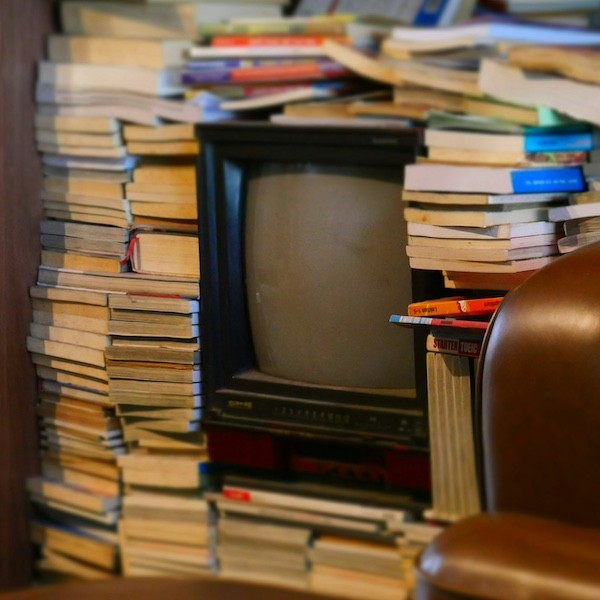
There was only one television set in their house and George insisted that it had to be kept in the kitchen. He felt that if put in the living room, the set would disturb the milieu, debase the shelves of leather-bound books, and defame the record player spinning Mozart. Whenever Patricia wanted to watch television, she had to sit in the corner of the kitchen where the square, twenty-inch screen shared counter space with her barnyard animal shaped oven mitts. The Corner of Shame, George called it, which he also called the basement where Patricia’s stacks of unread books and dusty knickknacks were required to be kept.
That very morning, Patricia had gone to the used bookstore and bought yet another book. It was one of the largest, thickest books in the store with gold letters stamped into its cover. Its pages too were edged in gold and its author had a French name Patricia couldn’t pronounce. Best of all, the book was old and musty-smelling and she doubted that George, or her daughters, had ever heard of it. The Vain and the Distrustful. She said the title over and over to herself as she drove home.
It’s not that she never read. Patricia bought books and tried to get through them all the time. But whenever she sat down with a book in her lap she’d grow bored and her mind would wander. George read Proust and Pynchon, Balzac and Dostoyevsky. “Is it possible you’re a touch illiterate?” George once asked. “I’m not trying to be insulting. I’m just hypothesizing here.”
Patricia’s daughters read like their father. They prided themselves on zipping through books thick enough with which to bludgeon someone to death. “Have you ever read a book this big, Mother?” Virginia, the eldest and namesake of Woolf, had once asked about a particularly large tome she was reading.
“Maybe in college,” Patricia said though she knew she had done no such thing.
“No, that doesn’t count,” Elizabeth, tribute to Barrett Browning, had chimed in.
“Yeah, Mother. It must be on your own and for fun.”
“Then I guess not,” Patricia had replied.
“We read books longer than Mom’s books,” Elizabeth exclaimed. The two had skipped off, most likely to share the news with their father.
Patricia vowed to finish The Vain and the Distrustful if it killed her. She went into the kitchen and started up the tea kettle. In the corner, the television seemed to be calling to her. Patricia looked at the stove clock. Three fourteen p.m. Sunday. Hot Kitchen would be on now. That was the show in which chefs had to prepare appetizers in a kitchen with its thermostat cranked up to one hundred and five degrees. Patricia resisted the distraction, made herself a cup of tea, and hurried into the living room before she could change her mind. She sat down in George’s leather chair, positioned as it was in the middle of an oatmeal-colored rug. Built-in bookshelves covered the walls from floor to ceiling. Her basement books weren’t allowed on these shelves. They held only George’s first editions, arranged alphabetically by author’s name.
Patricia often felt like she was one of George’s old books. He’d had her so long that most of the time he didn’t even notice her. He packed Patricia up and took her with him from place to place like an unspoken obligation. Wherever his life went, from Yale to graduate school at Stanford, then back east for a position at Columbia, Patricia went with him. From time to time he picked her up and gave her a read, but most often she just sat gathering dust.
When they’d met, they’d been kids and she’d been willing to fuck him. It was as simple as that. It’s not that other girls in their high school refused to have sex at all, it’s just that they refused to have it with George. But Patricia had never been one for entering competitions because she never won anything. The fact that no one would fight her for George made George all the more appealing. George responded to her because she pursued him, because she lied and told him she loved reading and classical music and her dream was to attend the ballet in New York City. Back then, George was working through Dante in Italian. Patricia was mature enough, even at sixteen, to understand that George’s intelligence would one day be an asset.
The first pages of The Vain and the Distrustful were an introduction by Percival G. Wells, a professor of literary studies at Oxford. He began with the birth of the author and went on for…she skipped to the end. Fifty pages. The introduction didn’t count towards reading the book, she decided. Patricia turned to the first page of the book and began to read. She felt herself flipping another page and then another. Had she read the first two pages of the book? If she had, she couldn’t say what had occurred there. She thought about turning back and reading the pages again, but the deal she’d made with herself was that she’d read the book cover to cover, not absorb every detail of it. She started on page three. A new character was introduced, Mister Leeward of Northshire. Or she thought he was introduced. Hadn’t she seen his name before in the first or second paragraph? He was a soldier, or a landowner, or a landowning soldier.
What were the chefs making on Hot Kitchen right now? Was she missing a new episode of I Do, You’re Dead? Patricia liked that show because of the reenactments. There were beautiful locales and equally beautiful actors holding hands and pretending to be in love. She enjoyed the beginnings of these stories even though she knew the sandy sunset stroll would soon devolve into a bloody stabbing. Patricia and George had honeymooned in London where he made her tour libraries and historic sites like dirty old churches. She had wanted to cruise the Mediterranean or sip a tropical drink in Hawaii, but George felt it was better if he planned their trip. He was more worldly, he reminded her.
But what to think of Mister Leeward. Or was it Lord Leeward? At this point, in the middle of page three, he was just referred to as Leeward. She thought of going back to learn if he was a commoner or gentry, as if the answer might provide some insight into his character. At some point the author would have to have Leeward introduce himself to someone, right? All her questions would be answered if she just kept moving forward.
Always moving forward had been Patricia’s strategy with George too. If she stopped to reflect on her desires, she would never get anywhere. She said yes when he proposed. There was no ring or candlelit restaurant. George had simply put down the Times and said, “Well, shall we get married?” The same conversation had preceded impregnation with Virginia. Elizabeth had been a mistake, but the sex that made her had been very premeditated. When George suggested Patricia stay home and raise the kids, she acquiesced to that too. Another chapter unfolded; her life penned by someone else.
Page four. “May I present Lord Leeward, the Seventh Duke of Northshire, said the Countess.” So Leeward was a Lord. Patricia didn’t know if she liked him more or less now. She read on for a few minutes though her mind was elsewhere. When she snapped back to consciousness and focus, she found herself on page nine roaming through an elaborate and tedious description of a meadow. The grass was dry and yellowing at the tip of each blade, she read. The grass was dry and yellowing. The grass was dry. The grass.
When Patricia awoke, her daughters were standing on either side of the armchair. “Mother, are you alright?” They stared down at her like aliens discovering a new lifeform. She didn’t know which one had spoken to her. “Oh,” Patricia said, regaining her awareness. “I’ve been so engrossed in this novel I must have drifted off.” Elizabeth reached over and pulled the book from her mother’s lap.
“The Vain and the Distrustful,” she read. “You’re reading this?”
“Yes, I am,” Patricia said.
“What page are you on?” asked Virginia. What page was she on? The book had closed when she fell asleep. She seemed to recall being in the first chapter, somewhere around page five or six.
“Page fifty-two,” she lied. “And I only just bought it today.”
“Not bad,” Virginia said.
“Dad’s going to be really impressed,” Elizabeth agreed.
“I’m not reading it to impress your father,” Patricia said. “I want to read it.”
Once upon a time she’d just been “Patty.” But George said that nickname made her sound like a down-on-her-luck musician who busked for coins on the subway. He preferred “Patricia” which he said carried notes of royalty and grace. With George, her name got longer and everything she owned became more expensive. Out went her clothes from the Macy’s sales racks and in came items purchased from small boutiques in the city. He made her get rid of the beat up, plush red chair she’d bought in a thrift store her senior year of high school. It was her favorite chair, but George said it didn’t “fit the aesthetic” he was going for in their shared apartment. The chair was out. Handcrafted oak end tables were in. Patricia had to admit that the items George selected, whether for her or for their home, were good quality. The oak end tables were still with them twenty years later. The only things that weren't here were her chair and her name.
Patricia tried to read the book. She really did. But every time she picked the novel up, there was always something else to do. Television shows to watch. Errands to run. One night, while George and the girls went to see some black and white subtitled movie, Patricia sat down and opened the book again. She peered into the pages of The Vain and the Distrustful, saw the type, the black and white letters making words, the words making sentences and paragraphs and pages. Sometimes a phrase jumped out at her. Pastoral and gentile. Unworthy of affection. Leeward had bought more land or married a commoner or died. She wasn’t certain.
When her family returned home, Patricia had The Vain and the Distrustful open to page two hundred and ten. “You’re flying through that,” said Elizabeth, a hint of admiration in her voice.
“So, how are you enjoying it?” George asked.
“It’s quite interesting,” Patricia replied. “A lot of interesting relationship dynamics.”
“How so?”
“You know, the portrayal of class systems and dynamics. A lot of very interesting dynamics.”
“Yes, interesting,” George said.
Later that week when Patricia was pretending to be on page four hundred and nineteen, George entered the house carrying a large shopping bag. “Girls,” he called out. “Come down here.” Once the family had gathered in the living room, George reached into the bag and pulled out a copy of The Vain and the Distrustful. He handed the book to Virginia then pulled out an identical copy and gave it to his younger daughter. Finally, a third copy came out of the bag. “And this one is for me,” he said.
“Why did you buy all these copies?” Patricia asked. “We already have it. I already have it.”
“I thought it would be fun if we all read it at the same time. Of course, we’re way behind you at this point,” George said. “But we’ll try to catch up.” He winked at his daughters and they giggled in unison, like murdered twins haunting a hotel.
“I don’t know,” Patricia said. “I’m kind of far in at this point.”
“That’s alright,” George said. “Now you’ll have someone to talk to about the book. Won’t that be fun? A family book club.”
“Yes, that will be fun,” Patricia said. She excused herself and went to her corner in the kitchen with her copy of the book in hand. With just the touch of a button, the television turned on and bathed her in soothing light. Onscreen, a detective was explaining how he solved the case of a woman who had been slowly poisoning her husband. She did it by stirring small amounts of rat poison into his morning tea. Patricia wondered what kind of tea the victim used to drink and if the Earl Grey George drank would be strong enough to cover any possible trace of arsenic.
“I now officially call the first meeting of the Taylor Family Book Club to order,” George said. It was only a few days after he’d bought the extra copies of the book but already he and the girls were just about caught up with Patricia. “Let’s start with the author’s introduction. I felt it gave significant context to the setting of the novel.”
“Oh, I did as well,” said Virginia. “The history of northern industrialization was a crucial set up for understanding Leeward’s family trajectory.” Elizabeth nodded in agreement.
“What do you think, Patricia?” George asked.
“I thought we could skip the introduction,” Patricia said.
“No, the introduction was written in the book for a reason. Why would you skip it?”
“It’s not really part of the story, now is it?”
“Oh, Mother. You’re just hopeless,” Virginia sighed. Elizabeth nodded in agreement.
“Well, then, we can skip our discussion of the introduction. Let’s talk about the first three chapters instead. What do we all think of Margaret’s ambitions? Patricia, why don’t you start.”
“Margaret’s ambitions. Yes, she’s very ambitious. It’s a commentary, um, I think, about opportunities and limitations.”
“Interesting,” George said. “Say more.”
“Just her ambition is clear and Leeward is part of that but…I don’t want to say too much and spoil anything that’s coming up,” Patricia replied. George stared at her for a few moments.
“Have you even read any of this book, Patricia?” he finally asked with a smirk.
“Of course I have.”
“So, tell me then, what is Lord Derbyshire’s secret? Where was the box of coins hidden? How did Lady Milford discover that her horse had been traded?” Three pairs of eyes were staring at her now. They all had the same eyes, George and her daughters. Hazel that turned from brown to green and back again like judgmental mood rings.
“I don’t…” Patricia stammered. The twins broke out into giggles.
“I knew it,” Virginia said. “I knew she wasn’t really reading it.”
“You were right. Looks like I owe you girls twenty dollars,” George said.
“Each,” Virginia reminded him.
“You took bets on whether I was reading the book?” Patricia asked. “Is that what this little club was all about?” The girls giggled again.
“That’s how it started,” Elizabeth said. “But the book is actually interesting, Mom. You should try reading it.”
“It’s ok. Not everyone is cut out for literature,” said George. “Some people are more suited to television watching.” Patricia felt a hotness spreading up her neck. Her face went red like her old plush chair. All around her were dusty leather-bound books, expensive furniture, and custom wallpaper. She was trapped. She couldn’t breathe. It was then that Patricia’s copy of The Vain and the Distrustful went sailing through the air. Later, she wouldn’t remember throwing it at George, but she would recall the thwack it made as it hit his knee and his cry of shock and pain.
“What the hell,” he said as he rubbed his leg. Her daughters’ eyes bugged out of their heads. Patricia grabbed two more books off the bookshelves and threw them at Virginia and Elizabeth. They screamed and she heard herself laughing. No one had ever been scared of Patricia before. Even the rabbits in the yard didn’t run away when she approached. But now she saw fear and confusion on her family’s faces, and she loved it. They had no idea what she would do next.
What Patricia did next was walk into the kitchen. She unplugged her little television set and gathered it into her arms. In the living room, George and the girls were frozen in place. They watched as Patricia carried the television over to the bookcase. With one sweep of her arm, she knocked all of George’s first editions to the floor. She plugged the television into the outlet and rested it on the now empty shelf. “Girls, bring those books down to the basement with the others,” Patricia said motioning towards the pile on the floor. A new episode of I Do, You’re Dead would be on in five minutes. George said Patricia’s name in an authoritative tone. She turned up the volume on the TV until she could no longer hear him.